Ski & Snowboard,
Gear Guides
Nov 10, 2026
Burton at 50: What Changed for the Everyday Snowboarder?
As Burton approaches fifty, its equipment history meets the everyday questions of board choice, boot fit and comfort on snow.
By Christy Sports Team
Last Updated November 10, 2026
Pull an older snowboard out of the garage and the memories might come back before the questions do. The graphic. The trip you bought it for. The friend who convinced you to try riding sideways.
Then you start looking at a new setup. Familiar names sit alongside different shapes, binding systems and boot options. Can you replace one piece? Will your boots work with those bindings? And does a more technical jacket actually mean a warmer one?
Ahead of Burton’s 50th anniversary in 2027, those everyday questions bring its history into focus. Nearly five decades of gear development become easier to understand when you pull on a boot or stand over a board.
Our Burton snowboard gear includes equipment, outerwear and the smaller pieces you reach for throughout the day. Understanding how those pieces work together helps you decide what belongs in your own setup.
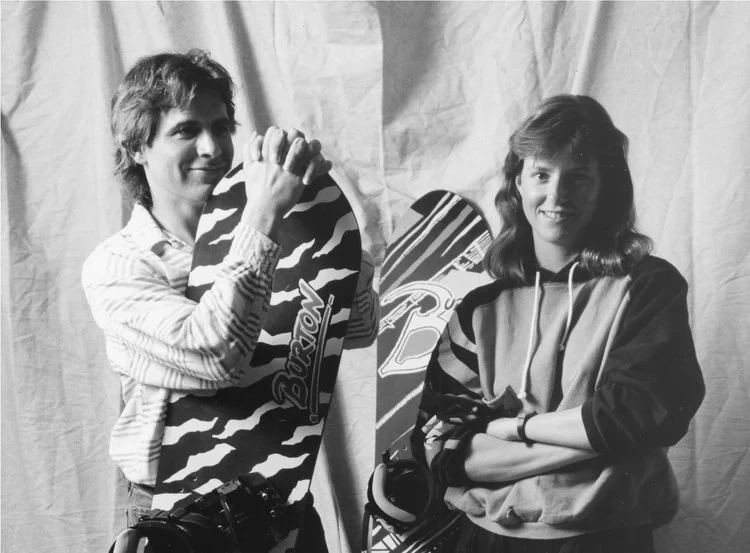
Burton’s story started with making room for snowboarding
Jake Burton Carpenter founded Burton Snowboards in Vermont in 1977. In Burton’s account of its beginnings, building equipment went hand in hand with supporting a team of top snowboarders and pushing resorts to allow snowboarding.
That gives the anniversary a little more weight than a collection of old graphics. A snowboard needs somewhere to be ridden. Equipment development and access to the mountain belong in the same story.
The company’s founding is one milestone in snowboarding’s broader history. Its contribution is a long-running part of a larger sport, shaped by the people who ride, build, teach and keep coming back each winter.
For today’s rider, that history raises a worthwhile question: when equipment changes, what does it help you do?
Sometimes the answer is a different way of connecting a boot to a binding. Other times it is as small as being able to adjust a cuff while wearing mittens, with snow blowing across the chairlift.
The Custom: a familiar name with a changing design
The Burton Custom makes a good starting point because its name has stayed familiar while the equipment has continued to develop.
According to Burton’s history of the Custom, the board was unveiled at a sales meeting in January 1995 and launched for the 1995/96 winter. Dave Downing tested the prototypes, and both Downing and Joe Curtes backed their development.
Decades later, Burton’s Custom Camber is still part of the conversation. Burton lists the current Custom Camber with camber, a directional shape and twin flex.
Those last two details are worth separating. Shape describes the board’s outline; flex describes how it bends. A board can have a directional shape and twin flex. Seeing “twin” in one specification does not mean every part of the design is symmetrical.
That distinction matters more than simply recognizing the name on the topsheet. When replacing an older board, tell a shop specialist how you ride now. Linking turns on groomers calls for a different conversation than practicing switch in the park. Your next board should reflect how you ride, even if your favorite graphic belongs to another decade. You can describe the experience in your own words; there is no need to arrive knowing every technical term.
Our snowboard guide organized by riding style is a useful next step when you want to move from the story behind a board to choosing one.

Step On changed the connection. Fit still comes first.
At the top of a run, getting your boots connected to your board is a familiar part of the routine. Step On offered another way to do it when Burton introduced the system in 2017: a boot-to-binding connection without conventional binding straps.
The appeal is easy to understand. Deciding whether it belongs in your setup takes a little more thought, especially if you have boots you already like.
Step On bindings require compatible Step On boots. Your conventional boots will not work with them, so changing bindings may also mean buying new boots. Burton explains that tradeoff in its Step On guide.
Start by trying on the boots. Pay attention to how they feel before deciding how you want to connect them to your board. A different binding system cannot make an uncomfortable boot the right fit.
Before you change your setup
Bring the details of your current board and boots when you talk with a shop specialist. You will want to work through a few things together:
- Boot and binding sizes: use the manufacturer’s current guidance to find the correct pairing.
- Board mounting: make sure the binding’s mounting interface and hardware work with your board.
- Entry and release: practice using the system according to the manufacturer’s instructions before your first run.
Think about the cost of the complete change, too. Replacing a binding is a different decision when it also means replacing boots that still work for you.
If your current setup feels right, there is no need to change it for the anniversary. But if you are curious about another way to connect, try the pieces together and ask questions before committing.
Our snowboard boots and bindings guide can help you work through the options.

The details you notice halfway through the day
Boards and bindings give you plenty to talk about before a trip. By the third chairlift ride, your attention might shift to the layer you wish you had packed or the gap between your mitten and sleeve.
That is where clothing deserves a little more thought. A cold morning and a sunny afternoon can call for different amounts of warmth. A shell lets you adjust the layers underneath, while an insulated jacket builds some warmth into the jacket itself. Burton’s women’s Reserve GORE-TEX 2L shell and men’s insulated Reserve jacket illustrate those choices. Start with whether you tend to run hot or cold and how you like to layer.
Then try everything on as you would wear it riding. Bend your knees and reach forward. Does the jacket pull across your shoulders? Can you get to your pass pocket without wrestling with the zipper? Leave enough time in the fitting room to find out.
Keep your mittens on for part of that process. The extended cuff on Burton’s Profile Mittens is a detail you can assess alongside your jacket: see how the two overlap and whether you can adjust them comfortably. A sleeve and mitten might each fit well on their own but feel awkward together.
These small interactions are part of choosing gear, too. They are worth paying attention to before you are standing in the snow with a glove off.
Our ski and snowboard apparel guide takes a closer look at outerwear and layering. For help choosing the pieces that complete your setup, explore our winter accessories guide.
What is worth carrying into the next fifty years?
Looking back at Burton’s history is a chance to appreciate how much thought can sit behind an ordinary day on snow. Even a small design decision deserves a practical question: will it help with something you actually encounter while riding?
Start your next gear decision with something you want to improve, and keep the pieces that already work. Describe the problem to a shop specialist and try the options together. There is no need to replace a whole setup to take part in an anniversary.
If you would like help working through a setup, find a Christy Sports store. Our stores in Fort Collins, Boulder, and Dillon, Powder Tools in Telluride, and Sturtevant's in Washington all have dedicated Burton brand experiences with staff specially trained to help guests with Burton gear. Bring your questions and the details of the gear you already own.
The 50th anniversary is a good reason to revisit the story. Your next day on the mountain is the reason to get the fit right.

Burton anniversary and gear questions
Burton history
When is Burton’s 50th anniversary?
Burton’s 50th anniversary is in 2027. Jake Burton Carpenter founded the company in Vermont in 1977. The 2026/27 winter leads into that milestone, so the anniversary celebration can begin before the calendar turns to 2027.
Did Burton invent snowboarding?
No. Burton’s founding in 1977 is a company milestone, not the invention of snowboarding. In its snowboard history timeline, Burton describes Jake Burton Carpenter’s interest in the earlier Snurfer. The company’s 2027 anniversary will mark fifty years of its own history, including equipment development and advocacy for resort access, within the larger story of the sport.
Choosing your gear
Can I use regular snowboard boots with Burton Step On bindings?
No. Step On bindings require compatible Step On boots. Use the manufacturer’s current size guidance to match the boots and bindings, then review the mounting requirements for your board. The same brand name on both pieces does not mean they will fit together.
Is the Burton Custom Camber a twin snowboard?
Burton specifies the current Custom Camber with a directional shape and twin flex. Those describe different parts of the design: the board’s outline and its flex pattern. Look up the exact Custom model and year you are considering; other versions may have different designs.
Does a GORE-TEX snowboard jacket automatically have insulation?
No. Weather protection and insulation answer different questions. Burton’s women’s Reserve GORE-TEX 2L Jacket is a shell, while the men’s Reserve GORE-TEX 2L Insulated Jacket includes 80g ThermacoreEco insulation. Look at the individual jacket’s construction and try it with the layers you plan to wear.
Where can I find Burton gear at Christy Sports for 2026/27?
Explore our Burton collection online for snowboards, boots and bindings, along with outerwear and accessories. Prefer to try things on and talk through your setup? Our Burton brand experience is available at Fort Collins, Boulder, Dillon, and Powder Tools Telluride in Colordo, and Sturtevant’s Bellevue in Washington. Find a store and contact the team about the gear you would like to see, since selection and sizes vary by location.
Ski & Snowboard,
Gear Guides
Nov 10, 2026
Burton at 50: What Changed for the Everyday Snowboarder?
As Burton approaches fifty, its equipment history meets the everyday questions of board choice, boot fit and comfort on snow.
By Christy Sports Team
Last Updated November 10, 2026
Pull an older snowboard out of the garage and the memories might come back before the questions do. The graphic. The trip you bought it for. The friend who convinced you to try riding sideways.
Then you start looking at a new setup. Familiar names sit alongside different shapes, binding systems and boot options. Can you replace one piece? Will your boots work with those bindings? And does a more technical jacket actually mean a warmer one?
Ahead of Burton’s 50th anniversary in 2027, those everyday questions bring its history into focus. Nearly five decades of gear development become easier to understand when you pull on a boot or stand over a board.
Our Burton snowboard gear includes equipment, outerwear and the smaller pieces you reach for throughout the day. Understanding how those pieces work together helps you decide what belongs in your own setup.
Burton’s story started with making room for snowboarding
Jake Burton Carpenter founded Burton Snowboards in Vermont in 1977. In Burton’s account of its beginnings, building equipment went hand in hand with supporting a team of top snowboarders and pushing resorts to allow snowboarding.
That gives the anniversary a little more weight than a collection of old graphics. A snowboard needs somewhere to be ridden. Equipment development and access to the mountain belong in the same story.
The company’s founding is one milestone in snowboarding’s broader history. Its contribution is a long-running part of a larger sport, shaped by the people who ride, build, teach and keep coming back each winter.
For today’s rider, that history raises a worthwhile question: when equipment changes, what does it help you do?
Sometimes the answer is a different way of connecting a boot to a binding. Other times it is as small as being able to adjust a cuff while wearing mittens, with snow blowing across the chairlift.
The Custom: a familiar name with a changing design
The Burton Custom makes a good starting point because its name has stayed familiar while the equipment has continued to develop.
According to Burton’s history of the Custom, the board was unveiled at a sales meeting in January 1995 and launched for the 1995/96 winter. Dave Downing tested the prototypes, and both Downing and Joe Curtes backed their development.
Decades later, Burton’s Custom Camber is still part of the conversation. Burton lists the current Custom Camber with camber, a directional shape and twin flex.
Those last two details are worth separating. Shape describes the board’s outline; flex describes how it bends. A board can have a directional shape and twin flex. Seeing “twin” in one specification does not mean every part of the design is symmetrical.
That distinction matters more than simply recognizing the name on the topsheet. When replacing an older board, tell a shop specialist how you ride now. Linking turns on groomers calls for a different conversation than practicing switch in the park. Your next board should reflect how you ride, even if your favorite graphic belongs to another decade. You can describe the experience in your own words; there is no need to arrive knowing every technical term.
Our snowboard guide organized by riding style is a useful next step when you want to move from the story behind a board to choosing one.
Step On changed the connection. Fit still comes first.
At the top of a run, getting your boots connected to your board is a familiar part of the routine. Step On offered another way to do it when Burton introduced the system in 2017: a boot-to-binding connection without conventional binding straps.
The appeal is easy to understand. Deciding whether it belongs in your setup takes a little more thought, especially if you have boots you already like.
Step On bindings require compatible Step On boots. Your conventional boots will not work with them, so changing bindings may also mean buying new boots. Burton explains that tradeoff in its Step On guide.
Start by trying on the boots. Pay attention to how they feel before deciding how you want to connect them to your board. A different binding system cannot make an uncomfortable boot the right fit.
Before you change your setup
Bring the details of your current board and boots when you talk with a shop specialist. You will want to work through a few things together:
- Boot and binding sizes: use the manufacturer’s current guidance to find the correct pairing.
- Board mounting: make sure the binding’s mounting interface and hardware work with your board.
- Entry and release: practice using the system according to the manufacturer’s instructions before your first run.
Think about the cost of the complete change, too. Replacing a binding is a different decision when it also means replacing boots that still work for you.
If your current setup feels right, there is no need to change it for the anniversary. But if you are curious about another way to connect, try the pieces together and ask questions before committing.
Our snowboard boots and bindings guide can help you work through the options.
The details you notice halfway through the day
Boards and bindings give you plenty to talk about before a trip. By the third chairlift ride, your attention might shift to the layer you wish you had packed or the gap between your mitten and sleeve.
That is where clothing deserves a little more thought. A cold morning and a sunny afternoon can call for different amounts of warmth. A shell lets you adjust the layers underneath, while an insulated jacket builds some warmth into the jacket itself. Burton’s women’s Reserve GORE-TEX 2L shell and men’s insulated Reserve jacket illustrate those choices. Start with whether you tend to run hot or cold and how you like to layer.
Then try everything on as you would wear it riding. Bend your knees and reach forward. Does the jacket pull across your shoulders? Can you get to your pass pocket without wrestling with the zipper? Leave enough time in the fitting room to find out.
Keep your mittens on for part of that process. The extended cuff on Burton’s Profile Mittens is a detail you can assess alongside your jacket: see how the two overlap and whether you can adjust them comfortably. A sleeve and mitten might each fit well on their own but feel awkward together.
These small interactions are part of choosing gear, too. They are worth paying attention to before you are standing in the snow with a glove off.
Our ski and snowboard apparel guide takes a closer look at outerwear and layering. For help choosing the pieces that complete your setup, explore our winter accessories guide.
What is worth carrying into the next fifty years?
Looking back at Burton’s history is a chance to appreciate how much thought can sit behind an ordinary day on snow. Even a small design decision deserves a practical question: will it help with something you actually encounter while riding?
Start your next gear decision with something you want to improve, and keep the pieces that already work. Describe the problem to a shop specialist and try the options together. There is no need to replace a whole setup to take part in an anniversary.
If you would like help working through a setup, find a Christy Sports store. Our stores in Fort Collins, Boulder, and Dillon, Powder Tools in Telluride, and Sturtevant's in Washington all have dedicated Burton brand experiences with staff specially trained to help guests with Burton gear. Bring your questions and the details of the gear you already own.
The 50th anniversary is a good reason to revisit the story. Your next day on the mountain is the reason to get the fit right.
Burton anniversary and gear questions
Burton history
When is Burton’s 50th anniversary?
Burton’s 50th anniversary is in 2027. Jake Burton Carpenter founded the company in Vermont in 1977. The 2026/27 winter leads into that milestone, so the anniversary celebration can begin before the calendar turns to 2027.
Did Burton invent snowboarding?
No. Burton’s founding in 1977 is a company milestone, not the invention of snowboarding. In its snowboard history timeline, Burton describes Jake Burton Carpenter’s interest in the earlier Snurfer. The company’s 2027 anniversary will mark fifty years of its own history, including equipment development and advocacy for resort access, within the larger story of the sport.
Choosing your gear
Can I use regular snowboard boots with Burton Step On bindings?
No. Step On bindings require compatible Step On boots. Use the manufacturer’s current size guidance to match the boots and bindings, then review the mounting requirements for your board. The same brand name on both pieces does not mean they will fit together.
Is the Burton Custom Camber a twin snowboard?
Burton specifies the current Custom Camber with a directional shape and twin flex. Those describe different parts of the design: the board’s outline and its flex pattern. Look up the exact Custom model and year you are considering; other versions may have different designs.
Does a GORE-TEX snowboard jacket automatically have insulation?
No. Weather protection and insulation answer different questions. Burton’s women’s Reserve GORE-TEX 2L Jacket is a shell, while the men’s Reserve GORE-TEX 2L Insulated Jacket includes 80g ThermacoreEco insulation. Look at the individual jacket’s construction and try it with the layers you plan to wear.
Where can I find Burton gear at Christy Sports for 2026/27?
Explore our Burton collection online for snowboards, boots and bindings, along with outerwear and accessories. Prefer to try things on and talk through your setup? Our Burton brand experience is available at Fort Collins, Boulder, Dillon, and Powder Tools Telluride in Colordo, and Sturtevant’s Bellevue in Washington. Find a store and contact the team about the gear you would like to see, since selection and sizes vary by location.