Patio
Jul 18, 2026
How to Choose the Perfect Patio Dining Set for Your Mountain Home

Know Your Hosting Profile First
Before dimensions or materials, figure out how you actually host. Mountain home dining patterns split into three types.
Weeknight household dining. Two to six people on a regular basis. You want a table that fits the space without dominating it, and chairs that are genuinely comfortable for 90-minute dinners. A 48-inch round or a 40-by-72-inch rectangular table tends to be the right scale here.
Weekend crew. Eight to twelve people a few times a season, with a smaller group most other evenings. An extension table earns its cost in this profile. Hanamint's Cedar collection includes a 42-by-76-inch table that extends to 100 inches, handling six on quiet nights and twelve when the house is full, without permanently taking over the patio.
Event hosts. Fifteen-plus, multiple times per summer. This almost always requires a dedicated dining zone paired with additional seating elsewhere. Plan for a 96-plus-inch table with swivel arm chairs that can shift toward the fire table between courses.
How Big Should Your Patio Dining Table Be?
A common mistake is buying the largest table the space will technically hold. Outdoor furniture needs circulation room: plan for at least 36 inches between table edge and wall or railing, and at least 48 inches if chairs pull out behind guests without people having to shuffle sideways.
Round tables encourage conversation across the full group and work well on square or octagonal decks. Seats typically max out around 6 for a 48-inch round and 8 for a 60-inch round.
Rectangular tables scale to larger groups and fit long or narrow patios. They also align better with rectangular pergolas and shade structures.
Oval tables split the difference: rounded ends ease traffic flow while the elongated center accommodates a larger group. If you're considering a Tropitone Kenzo setup for eight or more, the 42-by-84-inch Banchetto oval is worth a close look for tight rectangular decks.
Extension tables are increasingly popular in mountain vacation properties. The core table is sized for everyday use, and extensions add seats for full-house weekends. Keep in mind that extended configurations often require a market umbrella positioned to the side rather than centered through the table pole.
Round Tables
- Best for: Intimate groups, square decks
- Common sizes available: 48" to 60"
Rectangular Tables
- Best for: Large groups, long patios
- Common sizes available: 40"x72" to 42"x96"
Oval Tables
- Best for: Mid-size groups, tight rectangular spaces
- Common sizes available: 42"x84"
Extension Tables
- Best for: Variable group sizes
- Common sizes available: 42"x76" extending to 100"
Recommended Clearance by Table Type
- 48" round (seats 4-6): 10'x10'
- 40"x72" rectangular (seats 6): 10'x12'
- 42"x84" oval (seats 6-8): 10'x13'
- 42"x96" rectangular (seats 8-10): 10'x14'
- 42"x100" extended (seats 10-12): 10'x15'
Clearance assumes 36 inches on each end and each side. Add 6 inches per side on any wall where chairs pull out behind guests.
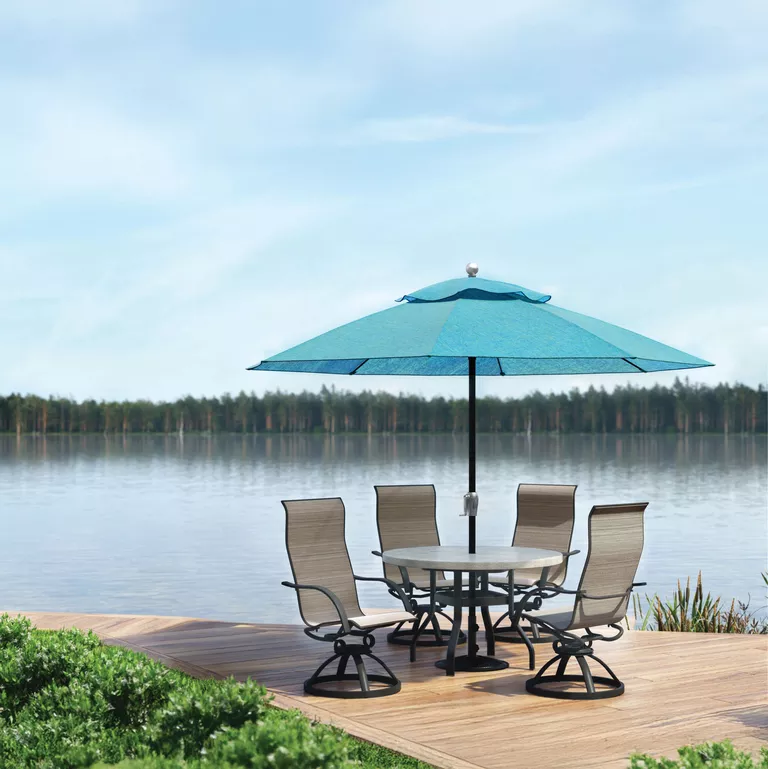
Stationary Chairs vs. Swivel Rockers
This is the decision most people underestimate before they've owned outdoor dining furniture for a full season.
Stationary dining chairs are typically lighter, often stackable, and work well for dedicated dining-only setups where people sit, eat, and move on. They're a good fit for households that keep casual seating separate from the dining area.
Swivel arm chairs with rocker bases let people turn to face the view, pivot toward a conversation across the patio, or shift position during a long, relaxed dinner. At altitude, where evenings on the patio routinely run from early dinner well past sunset, the ability to change orientation without scraping chairs on stone pavers makes a real difference. Most of the sets we carry can be configured with either option, and a mixed approach (swivel rockers for the host seats, stationary chairs for the rest) is a practical middle ground that works well in larger groups.
What Mountain Living Does to Patio Furniture
Mountain climates are harder on outdoor furniture than coastal or urban environments, in specific and predictable ways.
UV intensity. UV exposure increases roughly 4 to 5 percent for every 1,000 feet of elevation gain. At 8,000 feet, you're receiving 30 to 40 percent more UV than at sea level. Fabrics, finishes, and sealants that perform well at lower elevations can fade, chalk, or crack much faster at altitude. Look for powder-coated aluminum frames with UV-stable finishes and Sunbrella-grade or equivalent sling and cushion fabrics.
Temperature cycling. Mountain patios commonly see 40-degree swings between afternoon highs and overnight lows. Over thousands of cycles, materials expand and contract, loosening joints, cracking wood that isn't maintained, or stressing lesser-quality fabrics at the seams. Cast aluminum and recycled poly lumber handle temperature cycling well; solid teak with proper annual maintenance does too.
Wind. Wind is the most underestimated factor on exposed mountain patios, particularly on ridgeline decks in Summit County, exposed rooftops in Park City, and south-facing patios above Vail Valley. Lightweight furniture shifts in gusts and can tip or migrate across the deck. Heavier cast aluminum and recycled poly furniture offers meaningful stability without anchoring. Umbrella integration matters as well: if you're pairing a market umbrella with your dining set, choose a base designed for high-wind exposure. Our umbrella guide covers tilt mechanisms and base weights in detail.
Fire pit proximity. Many mountain patios pair a dining zone with a fire table for after-dinner use. Sling fabric is the most heat-sensitive option at close range; solid cast aluminum chair shells tend to be the most fire-adjacent-friendly choice. If your dining chairs will regularly sit within a few feet of an active fire table, raise that detail with your Christy Sports design consultant before finalizing. Learn more: Best Fire Pits for Colorado and Utah Patios 2026.
For a broader look at how materials compare across these variables, see our patio furniture materials guide.
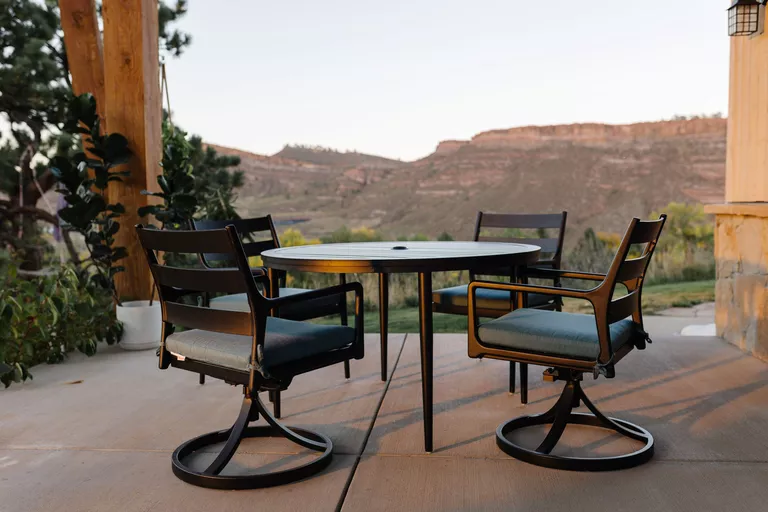
Top Dining Collections for 2026
These four collections cover most of what we hear from mountain homeowners: low maintenance, strong weather performance, genuine comfort for long evenings outside, and designs that hold up visually over multiple seasons.
Hanamint Cedar (Cast Aluminum)
Cedar is the most requested dining collection in our showrooms for good reason: it handles everything a mountain patio throws at it while looking properly intentional on a high-end deck.
The frame is cast aluminum, ornately detailed with a classic sculpted motif that reads more like poured iron than stamped metal. It's rust-proof, and the heavy-gauge casting gives it the wind stability that lighter extruded aluminum frames can't match. No cushions to bring in at the end of the night; the contoured seat and back casting provides solid ergonomic support on its own, though cushion upgrades are available.
The 42-by-76-inch Carlisle Extension Table is the most popular dining table in the collection, seating six comfortably and extending to 100 inches for twelve. For patios sized for a fixed footprint, the 48-inch round Carlisle Dining Table works well for four to six, and the 44-by-71-inch rectangular version handles a six-top with room to move.
View the Cedar collection, or visit any of our Colorado or Utah showrooms to see Cedar in person and work with a design consultant on table sizing for your deck.
Tropitone Kenzo (Sling and Woven Aluminum)
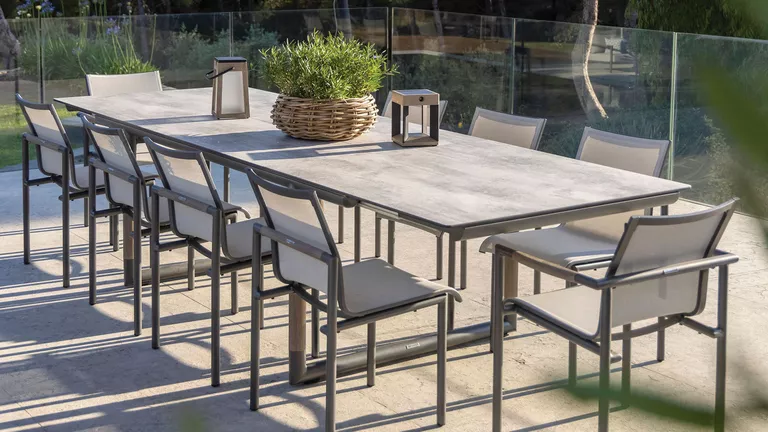
Kenzo is the collection for hosts who want a more contemporary aesthetic without sacrificing weather performance. The aluminum frames are clean-lined, and the sling seating delivers year-round comfort without any cushion maintenance.
Kenzo dining tables are organized into two sub-collections. Banchetto covers oval and round formats: the 42-by-84-inch oval for six to eight around a longer, narrower patio, and the 54-inch round for a compact four-to-six arrangement. Amici covers the rectangular format with the 42-by-96-inch table, which seats up to ten. Each table is compatible with Kenzo's full dining chair lineup, including standard stationary, swivel, and side chair options.
The sling fabric is UV-resistant and stays cooler in direct sun than cushions or solid surfaces, a practical advantage during peak-summer afternoon hours.
View the Kenzo collection, or stop by a showroom to compare sling options side by side and confirm which table format works best for your deck dimensions.
POLYWOOD Vineyard and Braxton (Recycled Poly Lumber)
POLYWOOD is the right answer for mountain homeowners who want zero maintenance alongside strong wind performance. The material is made from recycled plastic lumber. It won't rot, splinter, crack, or absorb moisture, and it requires nothing beyond occasional soap-and-water cleaning.
POLYWOOD furniture is notably heavier than aluminum, and on an exposed mountain deck that weight works in your favor. The added mass provides stability in wind without anchoring hardware. The Farmhouse Dining Table, available in a 37-by-72-inch rectangular format and a 48-inch round, is the flagship dining option across the Vineyard and Braxton collections.
Color selection is one of the real selling points. The palette runs from classic tones like Cloud Dancer and Vintage Blue to more distinctive options like Tidal Teal, Light Plum, and Hot Pink, which means POLYWOOD can serve as a color statement on a monochromatic deck or complement natural wood and stone surroundings.
View the Vineyard collection, available in more than 20 colors. Bring your deck dimensions to any showroom and we can help you identify which color reads best in natural mountain light.
Kingsley Bate Spencer (Teak Hardwood)
Spencer is for the buyer who wants furniture that improves with age. Teak is one of the few hardwoods that performs reliably in high-altitude outdoor environments: its natural oils resist moisture absorption, and it develops a silver-gray patina over time that reads as intentional rather than weathered.
The 60-inch round Algarve Dining Table seats six and is the anchor piece in the collection for most of our showroom customers. The 40-by-72-inch Wainscott Dining Table provides a rectangular option for hosts who need to seat eight.
The maintenance routine is simple but consistent: annual oiling with a teak-specific product keeps the wood in good condition and can restore the original warm honey tone if the silver patina isn't preferred. Many customers eventually choose to let it go gray and skip the annual treatment entirely. Teak weathers gracefully either way.
View the Spencer collection. Our design consultants can advise on the annual oiling routine and show you how the patina develops over time so you know exactly what to expect in your climate.
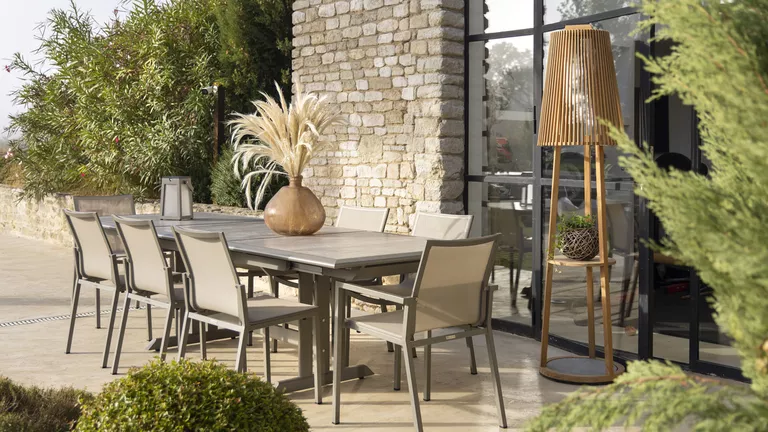
Mountain Patio Dining Set Checklist
Use this before your showroom visit or before you buy.
Space and fit
- Measured deck footprint with furniture in place, including at least 36 inches of circulation clearance on all sides
- Confirmed full extension dimensions work if considering an extension table
- Umbrella pole placement identified and compatible with your table's footprint
Hosting and comfort
- Identified your hosting profile (weeknight household, weekend crew, or event host)
- Decided between swivel rocker arm chairs and stationary dining chairs
- Chair count planned (one per seat plus two extras for flexibility)
Mountain climate
- Frame material chosen for your wind exposure and maintenance preference
- Fabric or finish UV-rated for your elevation
- Fire pit proximity considered if dining chairs will sit near an active fire table
Logistics
- In-stock pieces typically ship within a few days; custom orders run 4 to 8 weeks
- White glove delivery scheduled if needed (locally assembled, inspected, and installed)
- 30-day return window confirmed
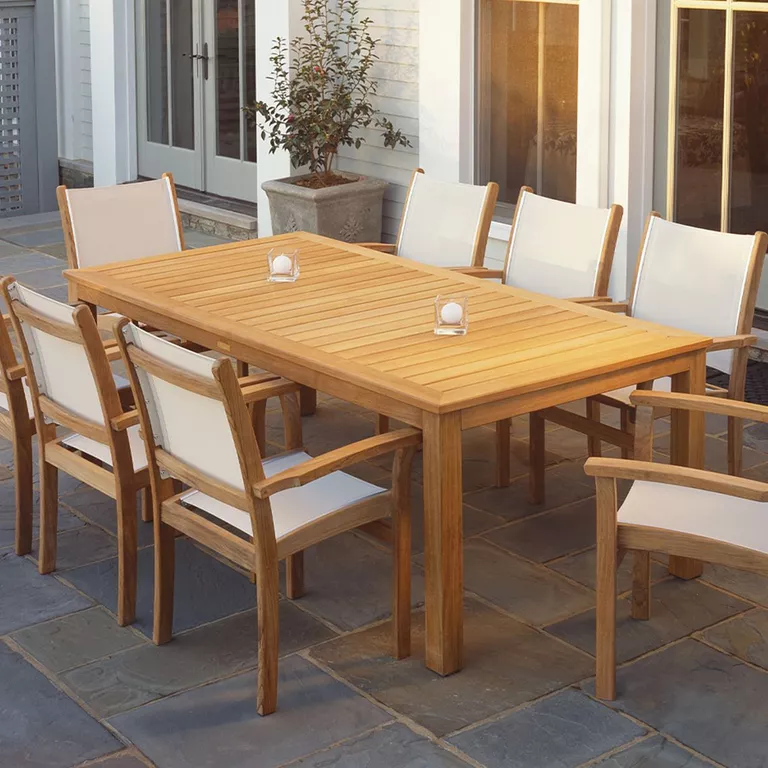
Frequently Asked Questions
How many chairs should a patio dining set include?
The standard recommendation is one chair per seat at the table, plus two additional chairs set aside for staging or secondary seating nearby. For an eight-seat table, budget for ten chairs. Mountain home patios often function as flexible spaces: dinner chairs migrate to the fire pit area after the meal, and having extras means you're not reconfiguring the dining table to accommodate late arrivals.
What is the best patio dining table size for a mountain deck?
The right size depends on the deck footprint and your hosting profile more than any universal rule. As a working framework: a 48-inch round or 40-by-72-inch rectangular table serves four to six and fits most mid-size decks with adequate circulation room. A table 84 inches or longer requires a deck at least 16 feet in the long dimension to maintain 36-inch clearance on each end. Extension tables are a popular solution when the deck can handle the fully extended length occasionally but not permanently.
Do sling chairs or cushion chairs perform better in mountain climates?
Both perform well when the underlying quality is there, but they have different maintenance profiles. Sling chairs require essentially no care: UV-resistant slings are fade-resistant and can be hosed off and left out. Cushion chairs offer more comfort customization and a softer aesthetic, but high-quality outdoor cushions should be stored or covered when not in use to extend their life at altitude. If your patio doesn't have covered storage nearby, sling is the lower-maintenance path.
Can cast aluminum patio furniture withstand mountain winters?
Cast aluminum is one of the most winter-tolerant patio furniture materials available. It won't rust, won't absorb moisture, and won't crack from temperature cycling. The main concern is heavy snow load on glass tabletops. Cast aluminum table frames handle snow without issue, but glass tops should be removed or covered through deep winter. Most of our mountain customers leave cast aluminum out under covers rather than moving it to storage.
What patio dining sets work best for high-wind mountain decks?
Weight and footprint stability are the primary factors. Cast aluminum and recycled poly lumber furniture provide better wind resistance than lightweight extruded aluminum. Low-profile furniture (specifically, tables without tall umbrella poles that can act as sails) helps as well. If you need overhead coverage, weight the umbrella base to at least 50 pounds and choose a tilt mechanism rated for high-wind conditions. Our umbrella specialists can advise on base sizing for your specific elevation and exposure. See our umbrella guide for more detail.
Is teak patio furniture suitable for Colorado and Utah mountain climates?
Teak performs well in mountain climates when properly maintained. Its natural oil content resists moisture absorption, and it handles temperature cycling better than most untreated woods. Annual oiling with a teak-specific product preserves the original color and keeps the wood from drying out at altitude. Without oiling, teak develops a silver-gray patina over two to three seasons, a look many owners prefer. The main caution is ensuring furniture is covered or stored during extended snow seasons, as prolonged snow contact can accelerate joint stress over many years.
See It in Person
All outdoor furniture at Christy Sports and Leisure Living is available for in-store review. Our showrooms carry deep floor inventory, with in-stock items available for same-week delivery. Services include free in-store design consultation, white glove delivery (locally assembled, inspected, and installed), and a 30-day return window on patio furniture purchases. Custom orders typically arrive in 4 to 8 weeks.
Colorado
- Arvada: 7715 Wadsworth Blvd | (303) 421-0261
- Avon: 182 Avon Rd | (970) 949-0241
- Boulder: 2000 30th St | (303) 442-2493
- Cherry Creek (Denver): 201 University Blvd | (303) 321-3885
- Colorado Springs: 5294 N Nevada Ave | (719) 597-5222
- Denver West (Lakewood): 14371 W Colfax Ave | (303) 271-0155
- Dillon: 817 US-6 | (970) 468-2329
- Fort Collins: 3500 S College Ave | (970) 223-4411
- Littleton: 8601 W Cross Dr | (720) 981-1761
- Park Meadows (Englewood): 9607 County Line Rd | (303) 708-8535
- Steamboat Springs: 1835 Central Park Dr | (970) 879-1250
Utah
- Salt Lake City: 3939 S Wasatch Blvd | (801) 272-5550
- Kimball Junction (Park City): 6622 N Landmark Dr | (435) 649-0311
- Leisure Living (Salt Lake City): 2208 S 900 E | (801) 487-3289
Find all patio showrooms: christysports.com/outdoor-living/patio-showrooms.html
More Inspiration for Your Mountain Patio
- Planning: How to Choose Patio Furniture for Colorado and Utah Homes (where to start on any mountain patio project)
- Materials: Best Patio Furniture Materials for Colorado and Utah Homes (aluminum vs. woven vs. teak vs. recycled poly, side by side)
- Umbrellas: The Complete Guide to Choosing the Right Patio Umbrella (2026) (sizing, tilt mechanisms, and base weights for mountain wind exposure)
- Fire pits: How to Choose a Fire Pit for a Colorado or Utah Patio (fire table heights, fuel types, and safe placement near dining furniture)
- Utah homeowners: Best Outdoor Patio Furniture for Utah Homes (Wasatch-specific guidance for Salt Lake City and Park City patios)
- Custom orders: Custom Patio Furniture in Colorado (when to order custom, how the process works, and what to expect on lead times)
Jonah Drescher has spent more than 30 years at Christy Sports, where he serves as Store Manager in Arvada. His expertise has been featured in Forbes Advisor, Travel + Leisure, The New York Times, Fox 31, 5280, and Apartment Therapy.
Patio
Jul 18, 2026
How to Choose the Perfect Patio Dining Set for Your Mountain Home
Know Your Hosting Profile First
Before dimensions or materials, figure out how you actually host. Mountain home dining patterns split into three types.
Weeknight household dining. Two to six people on a regular basis. You want a table that fits the space without dominating it, and chairs that are genuinely comfortable for 90-minute dinners. A 48-inch round or a 40-by-72-inch rectangular table tends to be the right scale here.
Weekend crew. Eight to twelve people a few times a season, with a smaller group most other evenings. An extension table earns its cost in this profile. Hanamint's Cedar collection includes a 42-by-76-inch table that extends to 100 inches, handling six on quiet nights and twelve when the house is full, without permanently taking over the patio.
Event hosts. Fifteen-plus, multiple times per summer. This almost always requires a dedicated dining zone paired with additional seating elsewhere. Plan for a 96-plus-inch table with swivel arm chairs that can shift toward the fire table between courses.
How Big Should Your Patio Dining Table Be?
A common mistake is buying the largest table the space will technically hold. Outdoor furniture needs circulation room: plan for at least 36 inches between table edge and wall or railing, and at least 48 inches if chairs pull out behind guests without people having to shuffle sideways.
Round tables encourage conversation across the full group and work well on square or octagonal decks. Seats typically max out around 6 for a 48-inch round and 8 for a 60-inch round.
Rectangular tables scale to larger groups and fit long or narrow patios. They also align better with rectangular pergolas and shade structures.
Oval tables split the difference: rounded ends ease traffic flow while the elongated center accommodates a larger group. If you're considering a Tropitone Kenzo setup for eight or more, the 42-by-84-inch Banchetto oval is worth a close look for tight rectangular decks.
Extension tables are increasingly popular in mountain vacation properties. The core table is sized for everyday use, and extensions add seats for full-house weekends. Keep in mind that extended configurations often require a market umbrella positioned to the side rather than centered through the table pole.
Round Tables
- Best for: Intimate groups, square decks
- Common sizes available: 48" to 60"
Rectangular Tables
- Best for: Large groups, long patios
- Common sizes available: 40"x72" to 42"x96"
Oval Tables
- Best for: Mid-size groups, tight rectangular spaces
- Common sizes available: 42"x84"
Extension Tables
- Best for: Variable group sizes
- Common sizes available: 42"x76" extending to 100"
Recommended Clearance by Table Type
- 48" round (seats 4-6): 10'x10'
- 40"x72" rectangular (seats 6): 10'x12'
- 42"x84" oval (seats 6-8): 10'x13'
- 42"x96" rectangular (seats 8-10): 10'x14'
- 42"x100" extended (seats 10-12): 10'x15'
Clearance assumes 36 inches on each end and each side. Add 6 inches per side on any wall where chairs pull out behind guests.
Stationary Chairs vs. Swivel Rockers
This is the decision most people underestimate before they've owned outdoor dining furniture for a full season.
Stationary dining chairs are typically lighter, often stackable, and work well for dedicated dining-only setups where people sit, eat, and move on. They're a good fit for households that keep casual seating separate from the dining area.
Swivel arm chairs with rocker bases let people turn to face the view, pivot toward a conversation across the patio, or shift position during a long, relaxed dinner. At altitude, where evenings on the patio routinely run from early dinner well past sunset, the ability to change orientation without scraping chairs on stone pavers makes a real difference. Most of the sets we carry can be configured with either option, and a mixed approach (swivel rockers for the host seats, stationary chairs for the rest) is a practical middle ground that works well in larger groups.
What Mountain Living Does to Patio Furniture
Mountain climates are harder on outdoor furniture than coastal or urban environments, in specific and predictable ways.
UV intensity. UV exposure increases roughly 4 to 5 percent for every 1,000 feet of elevation gain. At 8,000 feet, you're receiving 30 to 40 percent more UV than at sea level. Fabrics, finishes, and sealants that perform well at lower elevations can fade, chalk, or crack much faster at altitude. Look for powder-coated aluminum frames with UV-stable finishes and Sunbrella-grade or equivalent sling and cushion fabrics.
Temperature cycling. Mountain patios commonly see 40-degree swings between afternoon highs and overnight lows. Over thousands of cycles, materials expand and contract, loosening joints, cracking wood that isn't maintained, or stressing lesser-quality fabrics at the seams. Cast aluminum and recycled poly lumber handle temperature cycling well; solid teak with proper annual maintenance does too.
Wind. Wind is the most underestimated factor on exposed mountain patios, particularly on ridgeline decks in Summit County, exposed rooftops in Park City, and south-facing patios above Vail Valley. Lightweight furniture shifts in gusts and can tip or migrate across the deck. Heavier cast aluminum and recycled poly furniture offers meaningful stability without anchoring. Umbrella integration matters as well: if you're pairing a market umbrella with your dining set, choose a base designed for high-wind exposure. Our umbrella guide covers tilt mechanisms and base weights in detail.
Fire pit proximity. Many mountain patios pair a dining zone with a fire table for after-dinner use. Sling fabric is the most heat-sensitive option at close range; solid cast aluminum chair shells tend to be the most fire-adjacent-friendly choice. If your dining chairs will regularly sit within a few feet of an active fire table, raise that detail with your Christy Sports design consultant before finalizing. Learn more: Best Fire Pits for Colorado and Utah Patios 2026.
For a broader look at how materials compare across these variables, see our patio furniture materials guide.
Top Dining Collections for 2026
These four collections cover most of what we hear from mountain homeowners: low maintenance, strong weather performance, genuine comfort for long evenings outside, and designs that hold up visually over multiple seasons.
Hanamint Cedar (Cast Aluminum)
Cedar is the most requested dining collection in our showrooms for good reason: it handles everything a mountain patio throws at it while looking properly intentional on a high-end deck.
The frame is cast aluminum, ornately detailed with a classic sculpted motif that reads more like poured iron than stamped metal. It's rust-proof, and the heavy-gauge casting gives it the wind stability that lighter extruded aluminum frames can't match. No cushions to bring in at the end of the night; the contoured seat and back casting provides solid ergonomic support on its own, though cushion upgrades are available.
The 42-by-76-inch Carlisle Extension Table is the most popular dining table in the collection, seating six comfortably and extending to 100 inches for twelve. For patios sized for a fixed footprint, the 48-inch round Carlisle Dining Table works well for four to six, and the 44-by-71-inch rectangular version handles a six-top with room to move.
View the Cedar collection, or visit any of our Colorado or Utah showrooms to see Cedar in person and work with a design consultant on table sizing for your deck.
Tropitone Kenzo (Sling and Woven Aluminum)
Kenzo is the collection for hosts who want a more contemporary aesthetic without sacrificing weather performance. The aluminum frames are clean-lined, and the sling seating delivers year-round comfort without any cushion maintenance.
Kenzo dining tables are organized into two sub-collections. Banchetto covers oval and round formats: the 42-by-84-inch oval for six to eight around a longer, narrower patio, and the 54-inch round for a compact four-to-six arrangement. Amici covers the rectangular format with the 42-by-96-inch table, which seats up to ten. Each table is compatible with Kenzo's full dining chair lineup, including standard stationary, swivel, and side chair options.
The sling fabric is UV-resistant and stays cooler in direct sun than cushions or solid surfaces, a practical advantage during peak-summer afternoon hours.
View the Kenzo collection, or stop by a showroom to compare sling options side by side and confirm which table format works best for your deck dimensions.
POLYWOOD Vineyard and Braxton (Recycled Poly Lumber)
POLYWOOD is the right answer for mountain homeowners who want zero maintenance alongside strong wind performance. The material is made from recycled plastic lumber. It won't rot, splinter, crack, or absorb moisture, and it requires nothing beyond occasional soap-and-water cleaning.
POLYWOOD furniture is notably heavier than aluminum, and on an exposed mountain deck that weight works in your favor. The added mass provides stability in wind without anchoring hardware. The Farmhouse Dining Table, available in a 37-by-72-inch rectangular format and a 48-inch round, is the flagship dining option across the Vineyard and Braxton collections.
Color selection is one of the real selling points. The palette runs from classic tones like Cloud Dancer and Vintage Blue to more distinctive options like Tidal Teal, Light Plum, and Hot Pink, which means POLYWOOD can serve as a color statement on a monochromatic deck or complement natural wood and stone surroundings.
View the Vineyard collection, available in more than 20 colors. Bring your deck dimensions to any showroom and we can help you identify which color reads best in natural mountain light.
Kingsley Bate Spencer (Teak Hardwood)
Spencer is for the buyer who wants furniture that improves with age. Teak is one of the few hardwoods that performs reliably in high-altitude outdoor environments: its natural oils resist moisture absorption, and it develops a silver-gray patina over time that reads as intentional rather than weathered.
The 60-inch round Algarve Dining Table seats six and is the anchor piece in the collection for most of our showroom customers. The 40-by-72-inch Wainscott Dining Table provides a rectangular option for hosts who need to seat eight.
The maintenance routine is simple but consistent: annual oiling with a teak-specific product keeps the wood in good condition and can restore the original warm honey tone if the silver patina isn't preferred. Many customers eventually choose to let it go gray and skip the annual treatment entirely. Teak weathers gracefully either way.
View the Spencer collection. Our design consultants can advise on the annual oiling routine and show you how the patina develops over time so you know exactly what to expect in your climate.
Mountain Patio Dining Set Checklist
Use this before your showroom visit or before you buy.
Space and fit
- Measured deck footprint with furniture in place, including at least 36 inches of circulation clearance on all sides
- Confirmed full extension dimensions work if considering an extension table
- Umbrella pole placement identified and compatible with your table's footprint
Hosting and comfort
- Identified your hosting profile (weeknight household, weekend crew, or event host)
- Decided between swivel rocker arm chairs and stationary dining chairs
- Chair count planned (one per seat plus two extras for flexibility)
Mountain climate
- Frame material chosen for your wind exposure and maintenance preference
- Fabric or finish UV-rated for your elevation
- Fire pit proximity considered if dining chairs will sit near an active fire table
Logistics
- In-stock pieces typically ship within a few days; custom orders run 4 to 8 weeks
- White glove delivery scheduled if needed (locally assembled, inspected, and installed)
- 30-day return window confirmed
Frequently Asked Questions
How many chairs should a patio dining set include?
The standard recommendation is one chair per seat at the table, plus two additional chairs set aside for staging or secondary seating nearby. For an eight-seat table, budget for ten chairs. Mountain home patios often function as flexible spaces: dinner chairs migrate to the fire pit area after the meal, and having extras means you're not reconfiguring the dining table to accommodate late arrivals.
What is the best patio dining table size for a mountain deck?
The right size depends on the deck footprint and your hosting profile more than any universal rule. As a working framework: a 48-inch round or 40-by-72-inch rectangular table serves four to six and fits most mid-size decks with adequate circulation room. A table 84 inches or longer requires a deck at least 16 feet in the long dimension to maintain 36-inch clearance on each end. Extension tables are a popular solution when the deck can handle the fully extended length occasionally but not permanently.
Do sling chairs or cushion chairs perform better in mountain climates?
Both perform well when the underlying quality is there, but they have different maintenance profiles. Sling chairs require essentially no care: UV-resistant slings are fade-resistant and can be hosed off and left out. Cushion chairs offer more comfort customization and a softer aesthetic, but high-quality outdoor cushions should be stored or covered when not in use to extend their life at altitude. If your patio doesn't have covered storage nearby, sling is the lower-maintenance path.
Can cast aluminum patio furniture withstand mountain winters?
Cast aluminum is one of the most winter-tolerant patio furniture materials available. It won't rust, won't absorb moisture, and won't crack from temperature cycling. The main concern is heavy snow load on glass tabletops. Cast aluminum table frames handle snow without issue, but glass tops should be removed or covered through deep winter. Most of our mountain customers leave cast aluminum out under covers rather than moving it to storage.
What patio dining sets work best for high-wind mountain decks?
Weight and footprint stability are the primary factors. Cast aluminum and recycled poly lumber furniture provide better wind resistance than lightweight extruded aluminum. Low-profile furniture (specifically, tables without tall umbrella poles that can act as sails) helps as well. If you need overhead coverage, weight the umbrella base to at least 50 pounds and choose a tilt mechanism rated for high-wind conditions. Our umbrella specialists can advise on base sizing for your specific elevation and exposure. See our umbrella guide for more detail.
Is teak patio furniture suitable for Colorado and Utah mountain climates?
Teak performs well in mountain climates when properly maintained. Its natural oil content resists moisture absorption, and it handles temperature cycling better than most untreated woods. Annual oiling with a teak-specific product preserves the original color and keeps the wood from drying out at altitude. Without oiling, teak develops a silver-gray patina over two to three seasons, a look many owners prefer. The main caution is ensuring furniture is covered or stored during extended snow seasons, as prolonged snow contact can accelerate joint stress over many years.
See It in Person
All outdoor furniture at Christy Sports and Leisure Living is available for in-store review. Our showrooms carry deep floor inventory, with in-stock items available for same-week delivery. Services include free in-store design consultation, white glove delivery (locally assembled, inspected, and installed), and a 30-day return window on patio furniture purchases. Custom orders typically arrive in 4 to 8 weeks.
Colorado
- Arvada: 7715 Wadsworth Blvd | (303) 421-0261
- Avon: 182 Avon Rd | (970) 949-0241
- Boulder: 2000 30th St | (303) 442-2493
- Cherry Creek (Denver): 201 University Blvd | (303) 321-3885
- Colorado Springs: 5294 N Nevada Ave | (719) 597-5222
- Denver West (Lakewood): 14371 W Colfax Ave | (303) 271-0155
- Dillon: 817 US-6 | (970) 468-2329
- Fort Collins: 3500 S College Ave | (970) 223-4411
- Littleton: 8601 W Cross Dr | (720) 981-1761
- Park Meadows (Englewood): 9607 County Line Rd | (303) 708-8535
- Steamboat Springs: 1835 Central Park Dr | (970) 879-1250
Utah
- Salt Lake City: 3939 S Wasatch Blvd | (801) 272-5550
- Kimball Junction (Park City): 6622 N Landmark Dr | (435) 649-0311
- Leisure Living (Salt Lake City): 2208 S 900 E | (801) 487-3289
Find all patio showrooms: christysports.com/outdoor-living/patio-showrooms.html
More Inspiration for Your Mountain Patio
- Planning: How to Choose Patio Furniture for Colorado and Utah Homes (where to start on any mountain patio project)
- Materials: Best Patio Furniture Materials for Colorado and Utah Homes (aluminum vs. woven vs. teak vs. recycled poly, side by side)
- Umbrellas: The Complete Guide to Choosing the Right Patio Umbrella (2026) (sizing, tilt mechanisms, and base weights for mountain wind exposure)
- Fire pits: How to Choose a Fire Pit for a Colorado or Utah Patio (fire table heights, fuel types, and safe placement near dining furniture)
- Utah homeowners: Best Outdoor Patio Furniture for Utah Homes (Wasatch-specific guidance for Salt Lake City and Park City patios)
- Custom orders: Custom Patio Furniture in Colorado (when to order custom, how the process works, and what to expect on lead times)
Jonah Drescher has spent more than 30 years at Christy Sports, where he serves as Store Manager in Arvada. His expertise has been featured in Forbes Advisor, Travel + Leisure, The New York Times, Fox 31, 5280, and Apartment Therapy.